Friday, November 1, 2013

Limits to Growth

Priscilla Bremser—Middlebury College

For your next mathematical modeling project, download “AP Program Size and Increments” from collegeboard.org. Using the number of Advanced Placement exams given annually from 1989 (463,644 exams) to 2013 (3,938,100), develop a model that describes the growth of the program. In your analysis, discuss possible adverse consequences of such growth. I can suggest one or two.

The College Board tells students that AP courses will help them “stand out in college admissions.” Guidance counselors, along with college admissions officers, advise students to take the most challenging courses at their schools. Dutifully heeding this advice, high school students rush through the mathematics sequence to get to calculus, often taking as many as six other AP courses before they graduate.

At the end of this frenzy, a number of bright, hardworking students have weak algebra skills, effectively neutralizing any advantage they might have earned. They may have placed out of Calculus I, but they are only marginally prepared for Calculus II.

Over time the AP program has shifted from being a way to meet the needs of a few students who are ready for a challenge to a de facto admissions requirement for many who may not be. Having used their AP credit to get into Middlebury, a number of our students try to take calculus again, saying “I know I got a 5 on the exam, but I didn’t really understand it.” If placement into advanced college classes is truly the main objective, then something is amiss.

Breadth over Depth


Mathematics majors have told me that they didn’t see an ε or δ until junior year of college. Their AP Calculus courses did not include the precise definition of a limit, upon which calculus stands. The College Board’s course description calls only for “an intuitive understanding of the limiting process,” followed by a list of topics so exhaustive that I’ve never seen a single college course cover them all. Apparently “rigor” and “challenge” lie in breadth, not depth.


Students in high school AP programs who love mathematics may end up with a weak conceptual understanding of their favorite subject. Meanwhile, students better suited to a different math course feel compelled to take AP Calculus to enhance their transcripts. Once they all get to college, their math professors have some students who earned 5s on the exam as well as others who scored 3 or lower (58 percent of those who took the AB exam in 2013). At a conference I heard one mathematician say to another, “We’re trying to figure out how to deal with students who have taken the AP.” Join the club.

Figure the Expenses


Why has this happened? At $89 per exam, some grumble that it’s all about money. Defenders of the program would point out that the College Board is “a not-for-profit membership organization.” Still, nonprofits exist to perpetuate themselves and seem to be taking a grow-or-die approach. The majority of students who took the Human Geography AP exam in 2013— 67,070 of them—were in ninth grade. Are that many 14-yearolds truly mature enough to take a college-level course?

There’s no going back to the time when the AP program was simply a way for well-prepared students to get advanced placement. Indeed, at my own institution, the faculty voted down a proposal to do away with giving course credit for high AP scores, choosing instead to limit each student to five such credits. Meanwhile, the College Board advertises the program as a way to “save on college expenses.” College may be too expensive, but this purported remedy blithely disregards the significant differences between high school and college.

For extra credit on the modeling assignment, use demographic data to estimate the carrying capacity of this system. What will growth rates look like in the coming years? At what costs?


Priscilla Bremser is a professor of mathematics at Middlebury College. Her interests include number theory, mathematics education at all levels, and appreciating the Vermont landscape on foot, bicycle, and skis.

This article was published in the November 2013 issue of Math Horizons.

Thursday, September 12, 2013

i Can't Stand It Anymore

Travis Kowalski—South Dakota School of Mines and Technology

Complex numbers are essential tools of mathematics, providing beautiful connections between arithmetic and geometry, algebra and trigonometry, number theory and analysis. Unfortunately, few people outside the cloister of trained mathematicians know this. I teach a course on complex analysis, and each time I am dismayed to find that, even after 15 weeks of demonstrating how the use of complex numbers fundamentally unifies most mathematical concepts learned in undergraduate studies, there is still a nontrivial subset of students who say, “That’s nice and all, Dr. K, but they aren’t real. They’re still imaginary numbers.”

By its very definition the lamentable word “imaginary” describes something that does not exist or is utterly useless. Of course, these derogatory implications were just what Descartes had in mind when he coined the term “imaginary number” in 1637. Two centuries later, Gauss advocated the term “complex number,” but Euler’s introduction of the symbol i means that, no matter whatever else we may choose to call it, the adjective “imaginary” will always be associated with the root of –1. Students know what the letter i stands for. To them, it is a number that is imaginary and therefore irrelevant.

It is a self–fulfilling—and sadly self–defeating—prophecy. And so, it is time to retire i.

If the previous plea of “pejorative prejudice” is a bit of a stretch (or at least, needlessly alliterative), allow me to strengthen it with a bone fide mathematical argument for retiring Euler’s chosen notation. In a standard presentation, the complex number \(a+b\sqrt{-1}\) is identified with the point (a,b) in the plane. The way complex multiplication is defined, the effect on the plane of multiplying by \(a+b\sqrt{-1}\) is exactly the same as left multiplying each point (written as a column vector) by the real matrix
a -b
b a
and so multiplying by the complex unit \(0+1\sqrt{-1}\) is the 90° rotation
0 -1
1 0

Whatever one wishes to label this matrix, the letter I is off limits because I always refers to the multiplicative “identity” matrix. This suggests that I should not be used for the complex unit. In keeping with a consistent lettering scheme, I should represent the complex number whose multiplication coincides with that of I, but that’s just the multiplicative identity—that is, I should denote the real number 1.

What would be a better symbol? Why not just dust off the old $\sqrt{-1}$ notation and use that? Unfortunately, this is a choice fraught with peril. Following the traditional algebraic “rules of radicals,” we end up with paradoxes like \[-1=\sqrt{-1}\sqrt{-1}=\sqrt{(-1)(-1)}=\sqrt{1}=1\] A better proposal comes from multivariable calculus. In the notation of ordered pairs, complex multiplication takes the form (a,b)(c,d) = (ac bd, ad+bc). Using this and vector algebra allows us to write any point in the plane as

(a,b) = (a,0)(1,0)+(b,0)(0,1)
=a(1,0)+b(0,1)
=ai+bj

where i=(1,0) and j=(0,1) are the standard basis vectors for the plane. Not only does this provide one more piece of evidence to support the claim that the symbol i ought to refer to 1, it also means (a,b)=a+bj. This looks exactly like the standard form of a complex number with the vector j standing in for \(\sqrt{-1}\). Even more compelling, note that

jjj = (0,1)(0,1) = (-1,0) = -1,

so j is indeed a square root of –1.

Consequently, we should denote the complex unit by j or, if we want to emphasize its role as a complex number rather than a plane vector, the italicized letter j. In fact, electrical engineers already use exactly this same letter j, although their prime motivation is that i is already reserved for current.

Our main motivation is that the letter j doesn’t stand for anything in particular, and it most certainly doesn’t stand for “imaginary.” The symbol simply denotes a complex unit, a number that multiplies against itself to yield –1. It is a blank canvas on which to paint the utility of the complex number system, effectively banishing the confusion and distrust of that other letter, which shall no longer be named.


Travis Kowalski teaches mathematics at the South Dakota School of Mines and Technology.

This article was published in the September 2013 issue of Math Horizons.

Monday, April 1, 2013

Mathematical Habits of Mind

Karen KingNational Science Foundation 


When I look back on my own mathematical education, I have many people to thank for helping me develop productive mathematical habits of mind. I remember walking to the car with my dad on a bitter cold day on the way home from kindergarten, and I just had to understand how you could do subtraction with regrouping. Instead of brushing off my pesky questioning (and I was pesky), he explained it to me, writing in the frost on the car window to illustrate the ideas. Some years later, Linda Agreen, my Advanced Placement calculus teacher, made sure that I understood why the fundamental theorem of calculus was fundamental, even though that was not going to be on the AP test. These habits of seeking real understanding were solidified in the mathematics department at Spelman College, under Etta Z. Falconer and her colleagues.

Building on the foundation laid by my father and my other mathematics teachers, I learned the mathematical habit of doggedly pursuing a complete understanding of ideas. I also learned how to recognize when my understanding was not complete and the reasoning skills to address the situation.

Unfortunately, too many students of mathematics, whether in college algebra or abstract algebra, do not possess these productive mathematical habits of mind. Instead, they have picked up some bad habits along the way: a tendency to look for the quick answer, a lack of persistence when the answer is not obvious, memorization over understanding.

Why do I keep referring to reasoning skills as “mathematical habits of mind”? Because I believe that if we start thinking about these unproductive practices as habits of mind, it opens up a different set of strategies for addressing the problem. When Al Cuoco, Paul Goldenberg, and June Mark introduced the concept of mathematical habits of mind (The Journal of Mathematical Behavior 15, no. 4 [1996]), it was a powerful concept for rethinking K-12 students’ learning of mathematics.

Habits are behaviors we engage in unconsciously, but they are the result of a long evolution of choices we make at a young age. Habits of mind evolve from the choices that we make about how to think about ideas. Thus, my dad’s early intervention was important. At 5 years old, I was still making choices about how to learn. So were my teachers—in elementary school, high school, and beyond.

But too few students develop the habits of mind needed for more advanced mathematical learning. Presented with a problem with no obvious example to follow, a poorly trained student might start writing things down or try some calculations with no real strategy in mind. Faced with the task of learning to write proofs, a person without sound mathematical habits usually attempts to memorize various arguments instead of re-creating them from their internal logic. These habits may have served them well previously, but no longer.

Habits reflect what a person is likely to do in a given situation, especially a stressful one such as taking a test, and habits are notoriously hard to break. Smokers know that continuing to smoke has a high likelihood of leading to cancer and other diseases, but that knowledge alone is rarely sufficient for those who are trying to quit.

With this in mind, we need to ask whether the way mathematics is currently taught reinforces bad habits of mind. Is it too easy to get by for too long using bad mathematical habits? And where did these bad habits come from in the first place? The likely answer is that there are some entrenched teaching habits in need of attention.

Thinking in terms of habitual behaviors conjures up powerful analogies. How might we change our approach to learning—and teaching—math if we labeled as “unproductive habits of mind” those methods that serve us poorly? Just like the person who finally replaces smoking with a healthier habit—or better yet, who never starts in the first place—we will all be better served with healthier mathematical habits of mind.


Karen King is the former director of research for the National Council of Teachers of Mathematics. She has been a member of the mathematics education faculty at New York University, Michigan State University, and San Diego State University. 

This article was published in the April 2013 issue of Math Horizons.

Friday, February 1, 2013

What to Expect When You’re Electing

Stephen AbbottMiddlebury College 


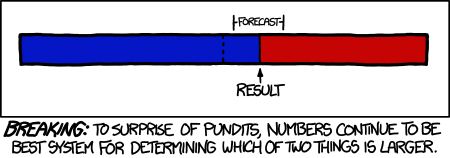
When the national election finally came to a merciful end in November, there was one universally recognized winner whose name did not appear on any ballot. In a stunning denouement, political blogger Nate Silver may have permanently altered the way elections are reported—and run for that matter—and he did so by staking his claim to the veracity of Bayesian statistics.


Like everything else in an election year, Silver’s story is nearly impossible to separate from its heated political overtones, but in this case it is worth a try. Not only was mathematics well served, but its objectivity emerged as a potential means for making headway into the political storms that lie ahead.

Nate Silver’s first statistical love was analyzing baseball, which he did successfully for a sports media company after college, but in the run-up to the 2008 presidential election Silver began applying his mathematical tools to political forecasting. In March of that year he started a blog called FiveThirtyEight and made a name for himself by correctly predicting the outcome of every state except for Indiana in the Obama-McCain race. With its star on the rise, FiveThirtyEight was picked up by The New York Times, just before the 2010 midterm elections. In anticipation of 2012, the Times signed Silver to a multiyear contract.


And this is where the plot thickens. In addition to being a first-rate statistician, Silver is also a self-professed progressive with ties to the Obama campaign. Thus, when Silver’s blog showed Obama with a comfortable polling edge going into the final weeks of the election, attacks from conservative pundits began to fly. Denigrating the messenger is standard procedure in elections, but Silver’s methods—i.e., his mathematics—also became fair game. An L.A. Times editorial characterized the FiveThirtyEight model as a “numbers racket.”


Referring to Silver, MSNBC’s Joe Scarborough proclaimed that “anybody that thinks that this race is anything but a toss-up right now is such an ideologue [that] they should be kept away from typewriters, computers, laptops, and microphones for the next ten days, because they’re jokes.”


Silver’s series of responses make for some pedagogically compelling reading. “There were twenty-two poles of swing states published Friday,” he wrote in a November 2, 2012, post. “Of these, Mr. Obama led in nineteen polls, and two showed a tie. Mitt Romney led in just one . . . a ‘toss-up’ race isn’t likely to produce [these results] any more than a fair coin is likely to come up heads nineteen times and tails just once in twenty tosses. Instead, Mr. Romney will have to hope that the coin isn’t fair.” Silver then goes on to give a razor-sharp explanation of the difference between statistical bias and sampling error and how one accounts for each in assessing uncertainty.


The FiveThirtyEight author’s mathematical rejoinders only agitated his antagonists, who vowed to make him a “one-term political blogger.” But on Election Day Silver’s model was correct for all 49 state results that were announced that evening. And what about Florida, which was too close to call for several days? Silver had rated it a virtual tie.


Predictably, this “victory for arithmetic” was quickly employed as weaponry in the red versus blue debate. This is as unfortunate as it is counterproductive, and here is why. If we can agree on anything in today’s political climate, it is the need for a more productive means of public discourse. If we ignore Silver’s political orientation for a moment, what we have is an illustration of how mathematics, in the proper hands, can provide an objective foothold when the partisan winds start to blow.


What could mathematics, and a mathematical approach that prioritized proof over punditry, contribute to our ongoing debates about climate change? The national debt? The relationship of gun laws to violent crime? What are the chances that some disciplined mathematical analysis might provide an objective first step in bridging at least some of our philosophical differences?


I’d rate it a toss-up.


Stephen Abbott is a professor of mathematics at Middlebury College and coeditor of Math HorizonsThis article was published in the February 2013 issue of Math Horizons.

Image by Randall Munroe (http://xkcd.com/1131/)

Thursday, November 1, 2012

Necessary Algebra

Paul ZornSaint Olaf College

I remember vividly the moment—and the room decor, the time of night, and the LP on the stereo—when my cousin Jon taught me algebra.

He and I, then seventh-graders, enjoyed those hoary old story problems (Al is twice as old as Betty; in seven years . . .) that once appeared in magazines such as Life and Look. I had concocted a simple strategy that one might charitably call iterative: Make any old integer guesses and tweak them as the errors suggest. What Jon first saw, and memorably pointed out, was that an unknown, say A, for Al’s age, can be manipulated as though it were a known quantity like one of my guesses.

What thrilled me then was the prospect of zipping through an entire genre of contrived puzzles. What amazes me still is the power of one simple idea: You can manipulate unknowns and knowns to solve equations.

That prescription seems a decent nine-word summary of what algebra does, even beyond the seventh grade. Jon and I got a preview, however dim, of an idea bigger and better than we could have suspected. Every student should encounter, and eventually own, an idea so simple and powerful. I’m convinced that almost every student has a fighting chance.

Is algebra necessary? 


So asked a provocative New York Times op-ed last July. In fact, the title is slightly misleading. Author Andrew Hacker, professor emeritus of political science at Queens College, doesn’t question algebra’s larger importance. He notes cheerfully that “mathematics, both pure and applied, is integral [Hacker’s good word] to our civilization, whether the realm is aesthetic or electronic.”

Hacker’s different but equally provocative question is how much “algebra,” that “onerous stumbling block for all kinds of students,” should be required in high school and college. His answer: Much less. And less of other mathematics, too.

Here “algebra” is in quotes because Hacker’s beef is not really with that subject in particular. Indeed, Hacker sees both “algebra” and existing curricula idiosyncratically. His examples of supposedly superfluous material—“vectorial angles” and “discontinuous functions”—are unlikely examples of “algebra” and even less representative of what is typically taught. And Hacker’s en passant endorsement of teaching long division (right up there with reading and writing) surprised me. He doesn’t acknowledge, or seem aware of, creative efforts to improve school teaching of “algebra” by teachers like those supported and mentored by, say, Math for America.

Hacker’s real curricular concern is broader than algebra: It’s the curricular complement of quantitative literacy (QL). He refers generally to “the toll mathematics takes” (my emphasis), not just to difficulties posed by algebra. In this sense Hacker’s three Rs proposal—require QR, but not “mathematics”—is more radical, and Philistine, than the article’s title suggests. But let’s concentrate on algebra.

Where he’s right, and wrong. 


Some of Hacker’s rhetorical targets are legitimate. Algebra can indeed be taught rigidly and applied ineffectively. (I remember the joy of solving algebra puzzles but also tedious hours of FOIL-ing quadratics.) Hustling high school students toward calculus sometimes pushes them too rapidly for effective mastery through prerequisite courses—including algebra. And Hacker, keen to avoid “dumbing down,” suggests some interesting applications of QL methods to such topics as the Affordable Care Act, cost/benefit analysis of environmental regulation, and climate change. (Whether such topics can really be approached without algebra is another question.)

As Hacker observes, few workers use algebra explicitly in daily life. (We all use it implicitly.) To infer that algebra can therefore vanish from required curricula is mistaken. Similar arguments might be made against history, the humanities, and the sciences generally, none of which is widely practiced in daily life. More important in curricular design than eventual daily use are broader intellectual values, which algebra clearly serves: learning to learn, detecting and exploiting structure, exposure to the best human ideas, and—the educational Holy Grail—transferability to novel contexts.

Transferability is undeniably difficult, as Hacker duly notes. The National Research Council agrees (see Education for Life and Work Report (pdf)) and indeed stresses the value of “deeper learning,” of which a key element is the detection of structure.

“Transfer is supported,” says the NRC, when learners master general principles that underlie techniques and operations.

Algebra is a poster child for deeper instruction. We should teach it. Students can learn it. 


Paul Zorn is a professor of mathematics at Saint Olaf College and currently serving as president of the Mathematical Association of America.

This article was published in the November 2012 issue of Math Horizons.

Saturday, September 1, 2012

Measuring Women’s Progress in Mathematics

Linda Becerra and Ron BarnesUniversity of HoustonDowntown

Many believe that residual effects of past hindrances and discrimination against women in mathematics are being overcome. Studies by the American Mathematical Society and National Science Foundation on women in mathematics appear to reinforce this belief. Conventional wisdom suggests it is only a matter of time before women achieve parity. Julia Robinson (instrumental in the solution of Hilbert’s tenth problem) suggested that one measure of parity would be when male mathematicians no longer consider female mathematicians to be unusual.

Unfortunately, a close reading of AMS and NSF data suggests that significant progress is not being made. One can be deceived by looking only at raw numbers without considering the related percentages.

Among entering students at U.S. institutions, data for the years 2000 to 2008 indicate the number of female and male freshmen expressing interest in a major in mathematics went from 44,500 and 49,500 in 2000, to 66,000 and 66,600 in 2008. These figures indicate the gap between female and male interest in majoring in math narrowed from 5,000 in the year 2000 to 600 in 2008. However, among all undergraduates, the percentage of females and males interested in a math major went from 0.6 percent (female) and 0.8 percent (male) in 2000, to 0.7 percent and 1 percent, respectively, in 2008. Hence, the percentage gap between the sexes increased during this time. This is because there was considerably higher growth in the overall female undergraduate population during this period.

Total graduate enrollment in the mathematical sciences increased from about 9,600 in 2000 to 22,200 in 2009 (131 percent), while female graduate enrollment increased from 3,670 to 7,979 (117 percent). However, the percentage of female graduate enrollment in the mathematical sciences remained relatively static in the decade—38 percent in 2000 and 36 percent in 2009.

AMS mathematics data noted that the number of Ph.D.s awarded to U.S. citizens in the mathematical sciences increased from 494 in 2000 to 669 in 2008, and the number of Ph.D.s awarded to women grew from 148 to 200. However, the percentage of Ph.D.s earned by women in 2000 and 2008 were both approximately 30 percent, with some variation in the intervening years. Also, the percentage of bachelor’s degrees awarded to females during this time varied little from 41 percent.

The NSF used a different data set, and the conclusions are even less encouraging. It indicates that women’s percentage of bachelor’s degrees in mathematics from 2002 to 2009 steadily decreased from 48 percent to 43 percent.

In mathematics, the number of doctoral full-time tenure/tenure-track (T/TT) positions held by women at U.S. institutions increased from about 2,850 in 2001 to 4,000 in 2009 (a 40 percent increase). However, the percentage of T/TT positions held by females increased only from 18 percent to 23 percent during this time. This smaller difference is explained by the fact that significantly more males also obtained T/TT positions in this period.

There are reasons to believe that women’s progress in mathematics should be much better by now. Since 1982, considering all fields, women have annually earned more bachelor’s degrees than men. By 2011, more women than men had earned advanced degrees. Yet, the statistics cited show that in mathematics, women’s participation at advanced levels is still unusually low and either improving slowly or, in some cases, making no progress whatsoever.

The real question is: How can meaningful progress be effected? Evidently the present strategies are not working.

A few ideas for consideration:

• Engage in a rigorous, sustained intervention with girls throughout school-level mathematics and in universities—not a few small programs, but a broad, concentrated, and sustained effort to integrate girls into mathematics, its culture, and its relevance. This effort must involve all the professional mathematical societies.

• Reengineer the culture in the mathematics professoriate with an eye toward more flexibility in the tenure and promotion process. The standards need not be watered down in any way, but the process should allow for a variety of pathways to meet them.

As Julia Robinson observed, “If we don’t change anything, then nothing will change.”


Linda Becerra and Ron Barnes are professors of mathematics at the University of HoustonDowntown.

Monday, April 2, 2012

My Conversion to Tauism

Stephen Abbott—Middlebury College, Math Horizons Co-Editor
There was no identifiable moment when I said, yes, I believe. My conversion must have come on silently and unexpectedly. I do, however, remember the moment when I realized something had inalterably changed...

Read the full article PDF


About the Author: Stephen Abbott is a professor of mathematics at Middlebury College and currently co-editor of Math HorizonsEmail: abbott@middlebury.edu 

Aftermath essays are intended to be editorials and do not necessarily reflect the views of the MAA.