Friday, February 1, 2013

What to Expect When You’re Electing

Stephen AbbottMiddlebury College 


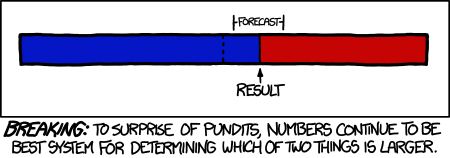
When the national election finally came to a merciful end in November, there was one universally recognized winner whose name did not appear on any ballot. In a stunning denouement, political blogger Nate Silver may have permanently altered the way elections are reported—and run for that matter—and he did so by staking his claim to the veracity of Bayesian statistics.


Like everything else in an election year, Silver’s story is nearly impossible to separate from its heated political overtones, but in this case it is worth a try. Not only was mathematics well served, but its objectivity emerged as a potential means for making headway into the political storms that lie ahead.

Nate Silver’s first statistical love was analyzing baseball, which he did successfully for a sports media company after college, but in the run-up to the 2008 presidential election Silver began applying his mathematical tools to political forecasting. In March of that year he started a blog called FiveThirtyEight and made a name for himself by correctly predicting the outcome of every state except for Indiana in the Obama-McCain race. With its star on the rise, FiveThirtyEight was picked up by The New York Times, just before the 2010 midterm elections. In anticipation of 2012, the Times signed Silver to a multiyear contract.


And this is where the plot thickens. In addition to being a first-rate statistician, Silver is also a self-professed progressive with ties to the Obama campaign. Thus, when Silver’s blog showed Obama with a comfortable polling edge going into the final weeks of the election, attacks from conservative pundits began to fly. Denigrating the messenger is standard procedure in elections, but Silver’s methods—i.e., his mathematics—also became fair game. An L.A. Times editorial characterized the FiveThirtyEight model as a “numbers racket.”


Referring to Silver, MSNBC’s Joe Scarborough proclaimed that “anybody that thinks that this race is anything but a toss-up right now is such an ideologue [that] they should be kept away from typewriters, computers, laptops, and microphones for the next ten days, because they’re jokes.”


Silver’s series of responses make for some pedagogically compelling reading. “There were twenty-two poles of swing states published Friday,” he wrote in a November 2, 2012, post. “Of these, Mr. Obama led in nineteen polls, and two showed a tie. Mitt Romney led in just one . . . a ‘toss-up’ race isn’t likely to produce [these results] any more than a fair coin is likely to come up heads nineteen times and tails just once in twenty tosses. Instead, Mr. Romney will have to hope that the coin isn’t fair.” Silver then goes on to give a razor-sharp explanation of the difference between statistical bias and sampling error and how one accounts for each in assessing uncertainty.


The FiveThirtyEight author’s mathematical rejoinders only agitated his antagonists, who vowed to make him a “one-term political blogger.” But on Election Day Silver’s model was correct for all 49 state results that were announced that evening. And what about Florida, which was too close to call for several days? Silver had rated it a virtual tie.


Predictably, this “victory for arithmetic” was quickly employed as weaponry in the red versus blue debate. This is as unfortunate as it is counterproductive, and here is why. If we can agree on anything in today’s political climate, it is the need for a more productive means of public discourse. If we ignore Silver’s political orientation for a moment, what we have is an illustration of how mathematics, in the proper hands, can provide an objective foothold when the partisan winds start to blow.


What could mathematics, and a mathematical approach that prioritized proof over punditry, contribute to our ongoing debates about climate change? The national debt? The relationship of gun laws to violent crime? What are the chances that some disciplined mathematical analysis might provide an objective first step in bridging at least some of our philosophical differences?


I’d rate it a toss-up.


Stephen Abbott is a professor of mathematics at Middlebury College and coeditor of Math HorizonsThis article was published in the February 2013 issue of Math Horizons.

Image by Randall Munroe (http://xkcd.com/1131/)

Thursday, November 1, 2012

Necessary Algebra

Paul ZornSaint Olaf College

I remember vividly the moment—and the room decor, the time of night, and the LP on the stereo—when my cousin Jon taught me algebra.

He and I, then seventh-graders, enjoyed those hoary old story problems (Al is twice as old as Betty; in seven years . . .) that once appeared in magazines such as Life and Look. I had concocted a simple strategy that one might charitably call iterative: Make any old integer guesses and tweak them as the errors suggest. What Jon first saw, and memorably pointed out, was that an unknown, say A, for Al’s age, can be manipulated as though it were a known quantity like one of my guesses.

What thrilled me then was the prospect of zipping through an entire genre of contrived puzzles. What amazes me still is the power of one simple idea: You can manipulate unknowns and knowns to solve equations.

That prescription seems a decent nine-word summary of what algebra does, even beyond the seventh grade. Jon and I got a preview, however dim, of an idea bigger and better than we could have suspected. Every student should encounter, and eventually own, an idea so simple and powerful. I’m convinced that almost every student has a fighting chance.

Is algebra necessary? 


So asked a provocative New York Times op-ed last July. In fact, the title is slightly misleading. Author Andrew Hacker, professor emeritus of political science at Queens College, doesn’t question algebra’s larger importance. He notes cheerfully that “mathematics, both pure and applied, is integral [Hacker’s good word] to our civilization, whether the realm is aesthetic or electronic.”

Hacker’s different but equally provocative question is how much “algebra,” that “onerous stumbling block for all kinds of students,” should be required in high school and college. His answer: Much less. And less of other mathematics, too.

Here “algebra” is in quotes because Hacker’s beef is not really with that subject in particular. Indeed, Hacker sees both “algebra” and existing curricula idiosyncratically. His examples of supposedly superfluous material—“vectorial angles” and “discontinuous functions”—are unlikely examples of “algebra” and even less representative of what is typically taught. And Hacker’s en passant endorsement of teaching long division (right up there with reading and writing) surprised me. He doesn’t acknowledge, or seem aware of, creative efforts to improve school teaching of “algebra” by teachers like those supported and mentored by, say, Math for America.

Hacker’s real curricular concern is broader than algebra: It’s the curricular complement of quantitative literacy (QL). He refers generally to “the toll mathematics takes” (my emphasis), not just to difficulties posed by algebra. In this sense Hacker’s three Rs proposal—require QR, but not “mathematics”—is more radical, and Philistine, than the article’s title suggests. But let’s concentrate on algebra.

Where he’s right, and wrong. 


Some of Hacker’s rhetorical targets are legitimate. Algebra can indeed be taught rigidly and applied ineffectively. (I remember the joy of solving algebra puzzles but also tedious hours of FOIL-ing quadratics.) Hustling high school students toward calculus sometimes pushes them too rapidly for effective mastery through prerequisite courses—including algebra. And Hacker, keen to avoid “dumbing down,” suggests some interesting applications of QL methods to such topics as the Affordable Care Act, cost/benefit analysis of environmental regulation, and climate change. (Whether such topics can really be approached without algebra is another question.)

As Hacker observes, few workers use algebra explicitly in daily life. (We all use it implicitly.) To infer that algebra can therefore vanish from required curricula is mistaken. Similar arguments might be made against history, the humanities, and the sciences generally, none of which is widely practiced in daily life. More important in curricular design than eventual daily use are broader intellectual values, which algebra clearly serves: learning to learn, detecting and exploiting structure, exposure to the best human ideas, and—the educational Holy Grail—transferability to novel contexts.

Transferability is undeniably difficult, as Hacker duly notes. The National Research Council agrees (see Education for Life and Work Report (pdf)) and indeed stresses the value of “deeper learning,” of which a key element is the detection of structure.

“Transfer is supported,” says the NRC, when learners master general principles that underlie techniques and operations.

Algebra is a poster child for deeper instruction. We should teach it. Students can learn it. 


Paul Zorn is a professor of mathematics at Saint Olaf College and currently serving as president of the Mathematical Association of America.

This article was published in the November 2012 issue of Math Horizons.

Saturday, September 1, 2012

Measuring Women’s Progress in Mathematics

Linda Becerra and Ron BarnesUniversity of HoustonDowntown

Many believe that residual effects of past hindrances and discrimination against women in mathematics are being overcome. Studies by the American Mathematical Society and National Science Foundation on women in mathematics appear to reinforce this belief. Conventional wisdom suggests it is only a matter of time before women achieve parity. Julia Robinson (instrumental in the solution of Hilbert’s tenth problem) suggested that one measure of parity would be when male mathematicians no longer consider female mathematicians to be unusual.

Unfortunately, a close reading of AMS and NSF data suggests that significant progress is not being made. One can be deceived by looking only at raw numbers without considering the related percentages.

Among entering students at U.S. institutions, data for the years 2000 to 2008 indicate the number of female and male freshmen expressing interest in a major in mathematics went from 44,500 and 49,500 in 2000, to 66,000 and 66,600 in 2008. These figures indicate the gap between female and male interest in majoring in math narrowed from 5,000 in the year 2000 to 600 in 2008. However, among all undergraduates, the percentage of females and males interested in a math major went from 0.6 percent (female) and 0.8 percent (male) in 2000, to 0.7 percent and 1 percent, respectively, in 2008. Hence, the percentage gap between the sexes increased during this time. This is because there was considerably higher growth in the overall female undergraduate population during this period.

Total graduate enrollment in the mathematical sciences increased from about 9,600 in 2000 to 22,200 in 2009 (131 percent), while female graduate enrollment increased from 3,670 to 7,979 (117 percent). However, the percentage of female graduate enrollment in the mathematical sciences remained relatively static in the decade—38 percent in 2000 and 36 percent in 2009.

AMS mathematics data noted that the number of Ph.D.s awarded to U.S. citizens in the mathematical sciences increased from 494 in 2000 to 669 in 2008, and the number of Ph.D.s awarded to women grew from 148 to 200. However, the percentage of Ph.D.s earned by women in 2000 and 2008 were both approximately 30 percent, with some variation in the intervening years. Also, the percentage of bachelor’s degrees awarded to females during this time varied little from 41 percent.

The NSF used a different data set, and the conclusions are even less encouraging. It indicates that women’s percentage of bachelor’s degrees in mathematics from 2002 to 2009 steadily decreased from 48 percent to 43 percent.

In mathematics, the number of doctoral full-time tenure/tenure-track (T/TT) positions held by women at U.S. institutions increased from about 2,850 in 2001 to 4,000 in 2009 (a 40 percent increase). However, the percentage of T/TT positions held by females increased only from 18 percent to 23 percent during this time. This smaller difference is explained by the fact that significantly more males also obtained T/TT positions in this period.

There are reasons to believe that women’s progress in mathematics should be much better by now. Since 1982, considering all fields, women have annually earned more bachelor’s degrees than men. By 2011, more women than men had earned advanced degrees. Yet, the statistics cited show that in mathematics, women’s participation at advanced levels is still unusually low and either improving slowly or, in some cases, making no progress whatsoever.

The real question is: How can meaningful progress be effected? Evidently the present strategies are not working.

A few ideas for consideration:

• Engage in a rigorous, sustained intervention with girls throughout school-level mathematics and in universities—not a few small programs, but a broad, concentrated, and sustained effort to integrate girls into mathematics, its culture, and its relevance. This effort must involve all the professional mathematical societies.

• Reengineer the culture in the mathematics professoriate with an eye toward more flexibility in the tenure and promotion process. The standards need not be watered down in any way, but the process should allow for a variety of pathways to meet them.

As Julia Robinson observed, “If we don’t change anything, then nothing will change.”


Linda Becerra and Ron Barnes are professors of mathematics at the University of HoustonDowntown.

Monday, April 2, 2012

My Conversion to Tauism

Stephen Abbott—Middlebury College, Math Horizons Co-Editor
There was no identifiable moment when I said, yes, I believe. My conversion must have come on silently and unexpectedly. I do, however, remember the moment when I realized something had inalterably changed...

Read the full article PDF


About the Author: Stephen Abbott is a professor of mathematics at Middlebury College and currently co-editor of Math HorizonsEmail: abbott@middlebury.edu 

Aftermath essays are intended to be editorials and do not necessarily reflect the views of the MAA.

Wednesday, February 1, 2012

Unduly Noted

Tommy Ratliff—Wheaton College
When I opened the MathFest program in Lexington last summer, I took one look at the first page and nearly yelled out loud “NO! NO! NO!” The inside cover to the program contained an advertisement for an online homework system with the following example:


Find the derivative of y = 2 cos(3x − π) with respect to x.

The assertion is that a competing system marked this answer as wrong, but the advertised system identified the expression as correct, demonstrating its superiority. I assume that the intent is to show that the system can recognize equivalent, but not identical, algebraic expressions. What caused me to react so strongly, however, is that I would have also marked the given answer as wrong. The answer should have been

The parentheses matter! The expression sin(x) represents a function!


I should be clear: My irritation is not directed at this particular homework system as much as at the entire mathematics community for the sloppiness in notation that we tolerate, and even encourage, when dealing with trigonometric functions. You can pick up almost any calculus text, peek into almost any math classroom, or attend any number of talks at various MAA events to find a plethora of examples of trig functions lacking their parentheses.


Why do I think the parentheses matter so much? This is not just a pedantic preference on my part. The lack of parentheses represents an irregularity in notation that obscures the meaning of the mathematics. We often use a space to indicate multiplication, as in or 3 sin(x), so leaving off the parentheses hides the fact that we are using a trigonometric function. The confusion is compounded when we say that the derivative of “sine” is “cosine.” If we were to be consistent, this would lead to applying a distorted product rule to get

I have seen students struggle with this, even when they understand the intent of the original notation. They correctly apply the chain rule only to confuse the order of operations at the end because they did not put the constant multiple of 3 at the beginning of the expression:

After all, why should you apply the cosine function to the first 3 in the 3x but not to the trailing 3? If we always used parentheses to enclose a function’s argument, then there would be no confusion.


An even worse abuse of notation occurs in the location of the exponent when a trig function is raised to a power. I will never write sin2(x) for sin(x)2 because the first notation leads to ambiguity when discussing the inverse trig functions. Since f− 1 (x) is the standard, consistent notation for the inverse function of f(x) , we also use sin− 1(x) for arcsin(x). If we were consistent with notation, a perfectly reasonable calculation would be

Notice that I had to make a choice about the meaning of sin−2 (x) in simplifying the expression—an impossible task! Should it be sin2(x)-1 = 1/sin2(x) or sin -1(x)2 = arcsin (x)2? The point is that we should never have to make this choice! We should be taking the derivative of the inverse sine function. This is horrific. The bad notation allows at least three different interpretations of the expression

We in the mathematics community pride ourselves on the consistency and deterministic nature of our discipline. I think we do ourselves a genuine disservice when we use sloppy notation that requires another layer of interpretation to understand the intended meaning. The purpose of mathematical notation is to provide clarity and, ideally, to provide insight into the mathematics being notated.


Therefore, I implore you: The next time you use a trig function, please remember the parentheses, put the exponent on the outside, and never, ever write anything like sin3x2 cos-25x.


Tommy Ratliff is a professor of mathematics at Wheaton College in Massachusetts where he enjoys thinking about voting theory, building new science centers, and being precise in his notation.

Tuesday, November 1, 2011

Statistics à la Mode

Meg Dillon—Southern Polytechnic State University

The last time I taught introductory probability and statistics, I turned in my grades and asked my department chair to take me off the course permanently. I’d spent some time working on a committee to update the course and we’d modernized it roughly to my taste, so my chair was puzzled. The best I could offer by way of explanation was, “I just hate it.” Then I went to France and taught their version of the same course.

My stint in France lasted three weeks. Essentially, I was substitute teaching and not looking for more than an excuse to be in the country for a while. My students were second-year engineering students, pretty much like my students at home. And like my students, the French students were a few notches below elite. While the similarities between my home university and my French university were comforting, the contrasts in the probability/statistics courses could not have been more jarring.

Anyone who has taught or learned in a U.S. mathematics department recently knows the typical introductory probability and statistics course. It involves an expensive, gassy textbook with lots of color pictures, word problems involving industrial applications, and charts to help students navigate problems. American students purchase the textbook and far too often, the ancillaries the bookstore peddles alongside the text.

At my home university, the chair has some difficulty finding mathematics faculty willing to teach the course. While I can’t speak for my colleagues, to me the course seems oddly estranged from mathematics. There is a section on probability, and we love that: the probability laws, the counting. It’s possible to trick out that section and get a chewier piece of mathematics into the act, but, by and large, the course is a hodgepodge of recipes, motivated by problems involving IQ testing, rhesus monkeys, salamanders, and the like. Regardless of the text, there is almost invariably a peculiar pair of caveats presented as from on high: Never accept the alternative hypothesis, and never say the probability is 0.95 that the mean lies in a 95% confidence interval for the mean. I dreaded teaching it in France.

The French course, though, was a different kettle of fish. No one expects French students to shell out money for books, so the course was based on notes produced by the instructor of record. The notes were spare and lacked attribution. They started with simple examples involving coins, dice, and lifetimes of electronic gadgets, what one would expect. The definition of sample space appeared on page one. (That was fast.) The definitions of sigma-algebra (Gasp! Are they joking?) and probability space (Is this a grad course?) appeared on page two. The course spooled out from there. Yes, it assumed more calculus than we do but mostly in the more interesting problems, and it treated testing and interval estimates in much the same way we do. No one was joking, and this was not a grad course: it was introductory prob/stats, in an unapologetically mathematical setting.

Statistics is possibly the most important course we teach in mathematics: for life and for cultural literacy, a basic understanding of it is essential. The high schools teach it, yet I’ve heard excellent high school math teachers express fear, if not loathing, of the subject.

An introductory probability and statistics course based on mathematics is missing, not just from the math education curricula, but from American soil altogether, as far as I can tell. While we teach these courses from bloated texts that avoid mathematics, we might seize the opportunity to teach a critical life skill—understanding statistics—through an exposition that glorifies its foundation in mathematics.

A big chunk of statistics courses in the United States are taught by non-mathematicians, outside math and statistics departments. By the looks of things, students can often get by on facility with software and a foggy understanding of principles. We still see many of these students in the introductory course, though. Could we do better there? Could we rope these students in with mathematical ideas, and could this happen anytime soon?

I don’t know, but I’m hoping to go back to teach in France next year.


About the author: Meg Dillon is a professor of mathematics at Southern Polytechnic State University in Marietta, Georgia.

Aftermath essays are intended to be editorials and do not necessarily reflect the views of the MAA.

Thursday, September 1, 2011

If You Think You Know It, Try to Teach It

Maggie Cummings—University of Utah

I am involved with a Math for America (MfA) project at the University of Utah that helps individuals with strong backgrounds in mathematics (typically a baccalaureate degree in mathematics) become secondary math teachers in high-needs schools. What has been extraordinary to me in this work is the gap between general mathematical knowledge and mathematical knowledge for teaching (MKT). This disparity has received significant attention in teacher education circles. (See, for example, Ball, Thames, and Phelps’s article, “Content Knowledge for Teaching: What Makes It Special?” in the Journal of Teacher Education 59[5], 2008.) The general theme of research in this area is that there is a difference between “doing” and “teaching” mathematics and that while teacher content knowledge is necessary for pedagogical knowledge and skill, the former does not guarantee the latter.

At the University of Utah, we are trying to develop a conceptual understanding of MKT at the secondary level and a means by which we might measure it. In particular, we are interested in identifying knowledge and skills that secondary mathematics teachers need but that are not necessarily possessed by those with degrees in mathematics. It may seem ridiculous to think that individuals with degrees in mathematics don’t know all the math they need for teaching secondary school students, but here are some concrete examples of where we see a gap:

How can you help a seventh-grade student mentally compute 35% of 80?

Why is the area of a trapezoid ½h(b1+b2)?

Is there a geometric reason that the slopes of perpendicular lines are negative reciprocals of each other?

How might you explain why 5 minus -7 equals 12, or why the product of two negative numbers is positive?

Why is anything to the 0 power equal to 1?

When our MfA fellows begin the program, most can provide the algorithms or rules related to the above topics, but when pressed, they generally are not able to give student-friendly explanations that connect a tangible model to the algorithmic procedure. For example, fellows usually set up a proportion to solve the problem of finding 35% of 80 (x/80 = 35/100), but do not know of any way to make this problem simple enough for students to compute the answer in their head. (One approach is to understand that 35% is three and a half groups of 10% portions. Ten percent of 80 is 8, so three of them would be 24 and another half [4] would give 28.)

Indeed, once they examine the conceptualization, the models are not just intuitive—they actually enhance prior understandings of our fellows. The issue is that (a) these conceptualizations are vital to the work of teaching mathematics and (b) they do not seem to be developed in conjunction with typical preparation in mathematics.

It is not enough for a secondary teacher to say a negative times a negative is a positive—she must also be able to engage students in understanding why this is the case and then how this logic can be applied to other situations. In a similar vein, it is not enough that a teacher knows that a student made a mistake in simplifying an algebraic fraction; he must also be able to identify what the student was thinking in the erroneous simplification process. That way, the teacher has a better chance of helping the student connect his or her understanding of numeric fractions to algebraic fractions.

As we prepare individuals with strong backgrounds in math to become teachers, what we have learned is that advanced content knowledge in mathematics must be deliberately linked to content-specific pedagogical knowledge and skills. If that linkage is not made, advanced content knowledge stays “siloed” in the instructor, where it doesn’t do the instructor or the students much good.

Individuals wishing to teach mathematics at the secondary level need more than a strong background in advanced mathematics; they need a strong foundation in the mathematics they are going to teach. So, while it is essential that secondary math teachers understand abstract algebra, it doesn’t necessarily translate into the ability to teach basic algebra. If the truest test of understanding an idea is being able to teach it to someone else, then even some of the strongest graduating mathematics majors still have much to learn about the foundations of their chosen subject. The more they are willing to learn, the more their future students will be likely to follow suit.


About the Author: Maggie Cummings is an instructor with the Center of Science and Mathematics Education at the University of Utah. Email: margaritacummings@gmail.com

Aftermath essays are intended to be editorials and do not necessarily reflect the views of the MAA.